
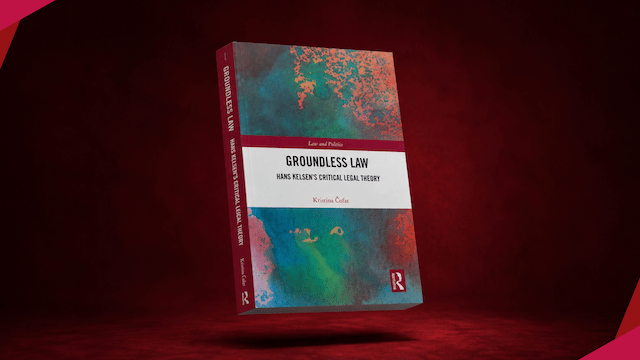
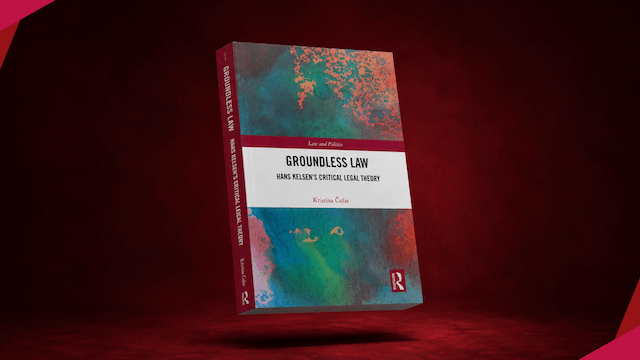
Dr Kristina Čufar, a researcher at the Institute of Criminology at the Faculty of Law in Ljubljana, has published the scholarly monograph Groundless Law: Hans Kelsen’s Critical Legal Theory, which critically examines the pure theory of law developed in the 20th century by one of the most influential legal theorists, Hans Kelsen.
The monograph focuses on the critical and radical potential of Kelsen’s “pure theory of law”, which, according to the author, has often been overlooked in traditional doctrinal interpretations. Kelsen understood law primarily as a system of norms that can be considered separately from morality, politics and ideology, while at the same time recognising law as a phenomenon inseparable from concrete political and social struggles. The tension between law as a normative system and its embeddedness in social and political reality is therefore one of the central questions explored in the monograph.
A key concept throughout the book is Kelsen’s Grundnorm (basic norm), which serves as a unifying thread for examining both the limitations and the potential of his legal theory. The book also explores the iconoclastic dimensions of Kelsen’s thought and the limitations of his neo-Kantian rationality, including his affinities with Friedrich Nietzsche’s philosophy and the deconstructive potential of his pure theory in dialogue with the work of Jacques Derrida.
The monograph concludes with a fresh restatement of the concept of Grundnorm, offering a new perspective on Kelsen’s seminal theory and situating it in the context of a world shaped and transformed by profound social and political crises.


