

On Friday, 10 October 2025, the Employment Service of the Republic of Slovenia organized the conference “Together Against Human Trafficking,” which brought together representatives of various institutions with the aim of strengthening cooperation in the detection, prevention, and prosecution of cases of forced labor and labor exploitation.
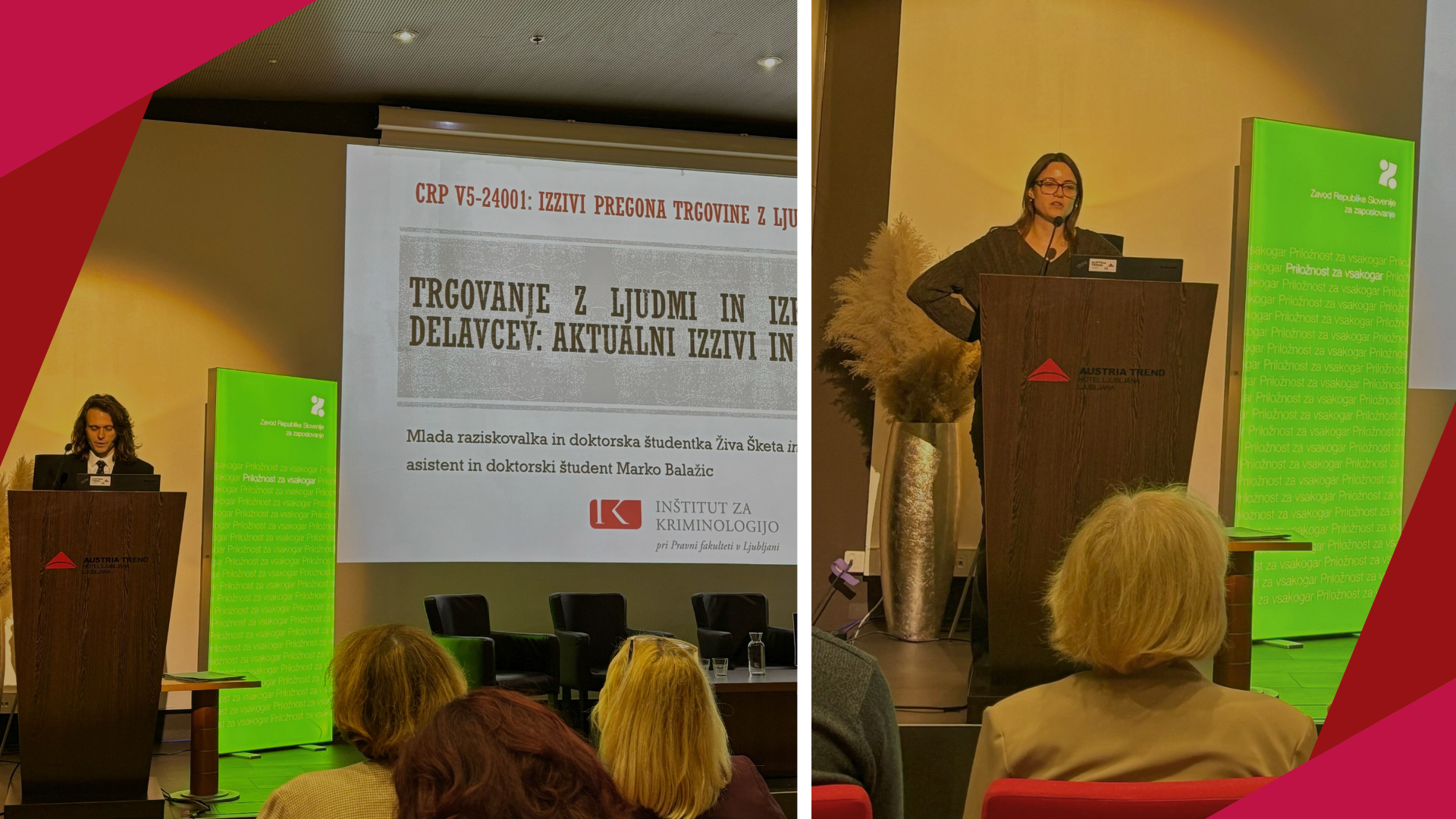
At the event, researchers from the Institute of Criminology, Marko Balažic and Živa Šketa, presented the results of the project Challenges in the Prosecution of Human Trafficking in Slovenia. As part of the project—which, among other things, focuses on the analysis of prosecutorial practices and case law relating to the criminal offense of human trafficking (Article 113 of the Criminal Code, KZ-1)—the research team found that prosecutors’ offices and courts most frequently deal with cases of human trafficking for the purpose of sexual exploitation (prostitution), while labor exploitation does not appear in court practice. Moreover, in prosecutorial practice, it is not recognized as human trafficking in the form of forced labor.
In comparison with foreign legal systems, they highlighted shortcomings in Slovenian legislation, where labor exploitation is not criminalized as a самостоятель offense. They explained how the purpose of forced labor within the framework of human trafficking is interpreted in practice and pointed to the possibility of a broader interpretation of this concept, as well as to the problematic lack of regulation of the activities of various intermediaries involved in the employment of foreign workers.
In the case of migrant workers, the situation often involves not only violations of labour rights but is also accompanied by various forms of coercion or deception.
The conference confirmed that effective prevention of human trafficking is only possible through close cooperation among all competent institutions and a strong commitment to improving the legislative framework.
The researchers also warned that in cases involving migrant workers who are heavily indebted and dependent on employers and various intermediaries (for accommodation, residence permits, administrative procedures, etc.), the situation often goes beyond mere violations of labor rights and is frequently accompanied by different forms of coercion or deception.


