
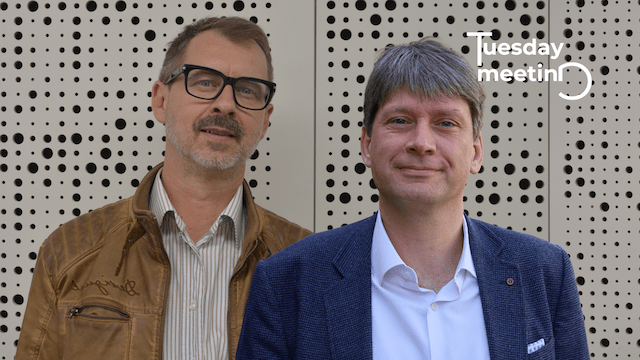
You are cordially invited to attend a lecture by Dr Borut Klabjan and Dr Gorazd Bajc entitled “The Complexity of the Bonfire at the Waterfront: Causes and Legacy of the Burning of the Narodni dom in Trieste.” The lecture will take place as part of the Tuesday Meetings lecture series on Thursday, 26 February 2026, at 14:30 in the library of the Institute of Criminology at the Faculty of Law, University of Ljubljana.
In their lecture, Dr Klabjan and Dr Bajc will examine why and how, on 13 July 1920, the Narodni dom in Trieste burned—both a symbol and a material embodiment of Slovene cultural, economic, and political achievement at the very heart of the city.
Why was it built? Whom did it threaten? Who was responsible for its destruction, and who were the eyewitnesses and witnesses to this first truly organized fascist act of violent mobilization—an event whose significance and long-term consequences transcended the local Upper Adriatic context and, in its own way, ignited Europe? What were the immediate and long-term repercussions, and within what broader historical framework did Slovenes pursue restitution—efforts that only began to materialize a century after the fire?
To address these and related complex questions, Klabjan and Bajc drew upon numerous previously unpublished sources, testimonies, and a wide range of significant scholarly works. Their analysis and (re)interpretation of both known and previously unknown evidence are presented in the monograph Ogenj, ki je zajel Evropo: Narodni dom v Trstu 1920–2020(Ljubljana: Cankarjeva založba, 2021), which has received considerable scholarly attention and was recognized among the most outstanding scientific achievements by the Slovenian Research and Innovation Agency. The last surviving witness to the fire, the renowned and now late writer Boris Pahor, urged everyone to read the book, noting that “[…] it contains the beginning of modern European history […] the entire complex of the birth of dictatorships in Europe.” In their lecture, the authors will present the key scientific findings of their research, which ultimately serves as a kind of mirror, helping us better navigate the history of a region whose development has been far less linear than commonly assumed—and precisely for this reason, profoundly fascinating.
Dr Borut Klabjan is a Research Councillor at the Science and Research Centre Koper and a Professor at the Faculty of Arts, University of Ljubljana. His research focuses on the political, social, and cultural history of Central and Eastern Europe in the nineteenth and twentieth centuries, with particular emphasis on border regions. He has published more than one hundred scholarly and professional articles in nine languages, authored two books, and co-edited five multilingual volumes. Since 2023, he has led the European Research Council project Cold War Europe Beyond Borders, which explores transnational cross-border practices in the Alps–Adriatic region from the Second World War to the present.
Dr Gorazd Bajc is a Professor in the Department of History at the University of Maribor, where he teaches the history of Europe, the Balkans, and Slovenia in the twentieth century. His research interests include the history of international relations, intelligence services, Yugoslav/Slovene–Italian relations, and the legal status of the Slovene minority in Italy. He has participated in several major research projects, including the European Research Council project EIRENE – Post-war transitions in gendered perspective, led by Prof. Dr Marta Verginella.
Contact person and event moderator: prof. dr. Matjaž Jager.
Audio and video recording of the event is not allowed.


